How to tell if a fawn needs immediate help.
1. Is the fawn laying on its side or curled up?
A fawn in distress will often lay on its side sprawled out instead of curled up with its head tucked.
2. Is the fawn walking around crying for its mom?
Hungry fawns will wander around, walking in large circles crying for its mother to come feed it. Think of a human baby crying when it is hungry.
3. Is it thin?
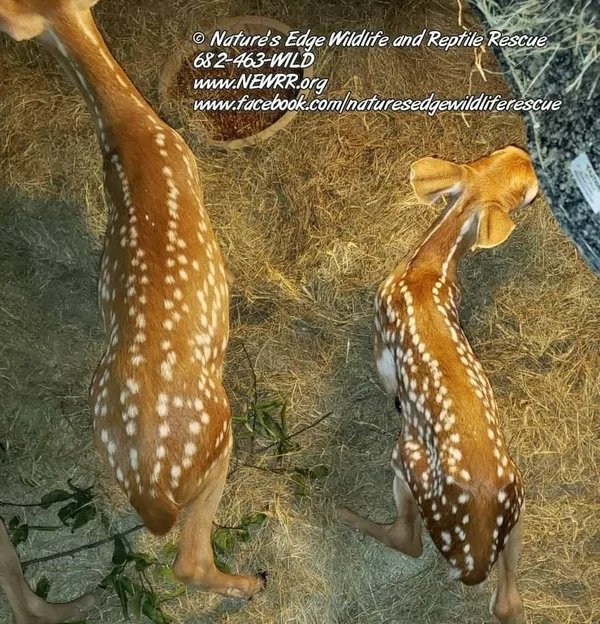
This can be a harder one to gauge. But look at the pictures we posted, notice the back hips and spine. One is very full, rounded, and healthy. The other is thin. Hip bones are very prominent and skin is sunk in around them. Spine is poking up along the back.
4. Is it covered in ants, flies, other bugs?
A healthy animal will not be covered in bugs. If you see maggots or fly eggs (little tiny yellowish grains that look like tiny rice) then that animal has an open wound somewhere and needs immediate attention. Time is important with maggots.
5. Curled ear tips
We hear this one a lot, but it is not always accurate. Curled ear tips...‘if it has curled ears, it needs help because it is dehydrated.’ This is NOT always the case. Fawn can have curled ear tips and be healthy or be dehydrated and have straight ear tips. Ears should NOT be used to determine if a fawn is hydrated or not.
And by all means, if you have questions, take a few pictures and get a hold of a rehabber near you that specializes in fawns.
Adult deer
Unfortunately, for the safety of humans and the animal, it is illegal in many states to rehabilitate adult deer. Reach out to your local wildlife rehabilitator to confirm applicable laws in your state.
Sources
- Nature’s Edge Wildlife and Reptile Rescue, Cleburne, Texas