
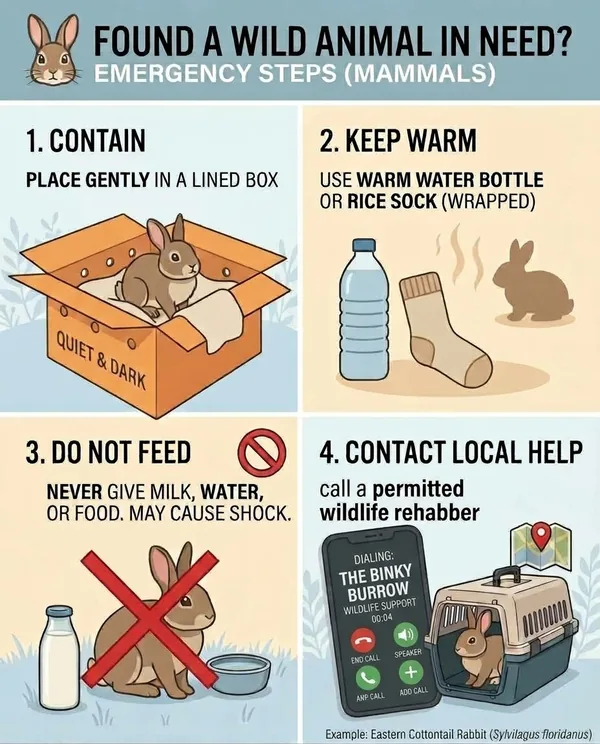
Saving a life begins with making sure an orphaned or injured animal has heat. Once you have safely contained the animal, to prevent escape, and given it a T-shirt for comfort and warmth as bedding, the next step is to supply warmth. If you still need the containment steps, see the injured or orphaned mammal containing guidance in the Educational Library.
Do not hold the animal or use your pocket
Holding the animal, or placing it in your pocket, is not an adequate or safe way to keep a baby warm. It is also terrifying for the animal; to the rescued animal, you are a predator.
Three ways to provide heat
Rice sock: Place 1 cup of uncooked rice in a sock. Tie or rubber-band the open end. Microwave the sock for 1 minute. If it is not warm, heat it for another 30–60 seconds, until the sock is warm but NOT HOT. If you do not have rice, try lentils or a similar product. The rice sock will generally hold the heat for a couple of hours.
Hot water bottle: Put hot water in a bottle and place the bottle in a sock, or wrap it with a cloth. This is a good solution if you are traveling or at the office.
Heating pad: If it will be several hours until you can transport the animal to a rehabilitator, use a heating pad set on low. It is very important to place the heating pad under one half of the container; never place the heating pad in the container. That keeps the animal from overheating, as it can move to the warm or cool side of the container. Caution: newer heating pads have automatic shut-offs that you may need to monitor if you are keeping the animal overnight.
Check the heat often
Check frequently, especially with little unfurred babies, as they cannot thermoregulate their body temperature. The rice sock and the hot water bottle will both need to be reheated, especially with unfurred babies. When you check on the baby, it should be warm, not sweaty or hot.
Traveling to a rehabilitator
The rice sock or the hot water bottle will travel with the animal while you are transporting it to a wildlife rehabilitator. Each can be reheated as needed, and normally each will hold the temperature long enough to transport the animal to a wildlife rehabilitator.
Sources
- DFW Wildlife Coalition, “Ways to provide heat for orphan or injured wild animal” (published September 10, 2018; updated March 13, 2019). Summarized by The Binky Burrow.